


Labyrinth, 1992 – 1999
Greek Theatre reflecting pond, Cranbrook Educational community grounds, Bloomfield Hills, Michigan, USA
About the work
For thousands of years, the Labyrinth has been created as public art with a purpose to either inspire hope or fear in the viewer (depending on the circumstance). The name Labyrinth dates back to pre-greek origin. Historically these often, extremely complex, maze-like sculptures have been used to evoke the inner experience of becoming lost so that one can be found. This particular Labyrinth was composed of compressed Canadian sphagnum peat moss as a substitute for Irish turf which was used extensively as a fuel to heat the cottages of rural, historical Ireland. Since the artist, Dr. Lycia Trouton, was raised both in Canada and in Ireland, the materials of this Earthwork are allegorical to her past.
“The labyrinth is symbolic of the journey of the soul…” – Lycia


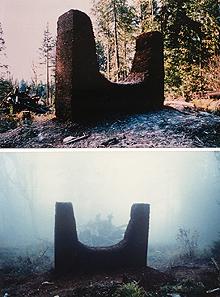


Bull’s Horn Hogfuel, 1992
UBC Research Forest, University of British Columbia, Canada
About the work
This outdoor sculpture is unique in that it is situated amongst panoramic views of a beautiful, West Coast rainforest. The U-shape that it takes on is fabled to be emblematic of regeneration and renewal, and is a reference to the Palace of Minos at Knossos, in Ancient Crete. There has been much deforestation and ‘slash and burn’ in this region of the world. This cedar bark Earthworks wishes to create a dialogue for hope around the future of the once fertile land of the Fraser Valley in Vancouver’s lower mainland.
“May our earth become a canvas for renewal rather than destruction.” – Lycia

Terra Flux (in collaboration with David Scott-Risner), 1998
Horsehead International Sculpture Exhibition,
abandoned Sandpoint Naval base, Seattle, Washington, USA
About the work
Living land art sculpture is not just about the shape and mass of the creation itself; it is rather a holistic, changing monument that cycles through the stages of organic biorhythm, as all of nature does. This living sculpture was made with compressed soil, the interior of which is a hollow column (built from marine-grade plywood) filled with water which was released into the soil cube through a series of weep holes and sprayers. Both wild and inserted seeds grew over a four month period, changing the earth cube as an intended part of the sculpture. The entire concrete basin was ‘washed’ with a spray from the PVC piping along its length–set to a timer, every hour. A pump funneled the water into the column itself. The result of this collaboration is the sound of the water, the birds and insects which gathered, including a host of dragonfly larvae, all becoming a part of the greater work.


BioLogical Time – Serpentine Knowledge, 1997
Location: Whitman College, Walla Walla, Washington, USA
About the work
Wheat has been our sustenance and staple, as well as our means for connecting with each other, ‘breaking bread,’ dating back over 10,000 years. Walla Walla, the interior of Washington State, is a wheat farming area and this contributes to the economy of the region. The serpent too has been a symbol for life, health and rebirth dating back to Vedic texts. What creates this earthwork is wheat planted in a serpentine formation on Whitman College green, outside of the school’s gallery. Dr. Lycia Trouton also created an indoor sculpture (a walk-in architectural space, made out of 300 bales of wheat straw) on the College premises. The ground here was rototiller-ed in June and the seeds planted for a full golden-yellow harvest the following September.